A Melodious Sonnet

  • Home
  • About Me
  • Contact Me
  • Legal Things
    • Disclosure
    • Privacy Policy

3 Resources to Help You Work More Productively

May 8, 2015 by Esther Filbrun · Leave a Comment

8 May

I don’t think there’s anything I like better than a free program that helps me work more productively. And, being somewhat of a program maniac—I usually end up trying out just about every free one I hear of—this is the kind of post I love the most. If you’re interested in free, time-saving resources, then this post will fit you as well.

3 Resources to Help You Work More Productively

Photo courtesy of Pixabay/condesign | License: CC0 1.0

Today, I’d like to share three valuable l tools I use to work more productively. Two of the resources below were ones I mentioned in the two previous posts in this series—How to Prepare for a Productive Day and 7 Effective Ways to Get Unstuck Now. The other is one I’ve come across in the last month or so, and it’s been so helpful to me in this area that it deserves its place as well.

Let’s get started.

1. Workflowy—“Organize Your Brain.” WorkFlowy is a notebook for lists. Use it to be more creative and productive.

A few months ago, I was feeling pretty stressed out over the sheer amount of work I had to do yet, so I sat down and had a brain-clearing session that was (at most) 30 minutes long. In that one session I wrote down over 50 things I needed to do. As soon as they were all written down it was much easier to focus on the project at hand and finish it. Workflowy is perfect for jobs like this—you can nest tasks as deeply as you like, and you can view them all together as one good-sized to-do list. Below is an example of how it looks:

WorkFlowy Screenshot

WorkFlowy Screenshot

(Note: If you sign up to use this task-management site, use my referral code here or above. By using my link, you will get 2x the amount of free space (500 monthly items instead of 250), and you will also be giving me an extra 250 per month. Thank you!)


2. Action Item Catcher—A place to capture action items for processing or doing later. (Scroll almost to the bottom of the page to get it.)

I find this simple “catcher” extremely helpful. It takes less than a minute to write something down, and is also very handy when I’m trying to remember what I need to do and/or figuring out what I should be doing the next day or week.


3. Momentum, Browser Extension for Chrome—Daily motivation and focus on your new tab page.

Momentum is a free extension that controls what your New Tab page looks like. Some of its main features include:

  • A beautiful new picture each day
  • To-do list
  • Main focus of the day
  • Daily inspiring quotes
  • Current time (helpful if you tend to lose track of time like I do)
Momentum Screenshot

Momentum Screenshot

I love this extension. It’s basically a personal daily dashboard. It is simple, yet elegant, in design, and instead of distracting from what I want to do each day it constantly reminds me of the next step I need to take. This is one of my main to-do list programs. I love the motivation it gives each day—whether the beautiful picture, or the quote, or both—it makes getting jobs done that much more fun.

Extra: I just found out that this extension is also available for Safari—check it out here in the Apple store. It’s also available for Firefox and the Edge browser. 🙂

For Opera—I’ve heard you can use Chrome extensions on Opera. If you install an add-on named Download Chrome Extension, you can install Chrome extensions as well as Opera extensions. This means that if you use Opera instead of Chrome, there is a chance you might be able to use Momentum. I haven’t personally tested this, so I can’t tell you about results, but it may be an option for you.


I hope you’ll be able to find something to help you work more productively. I also hope you won’t feel obligated to try anything that I recommend, simply because it works for me. If something is helpful, great! If it doesn’t help–maybe you’re already doing as well as you can, or perhaps there’s something else out there that would be better.

Whatever you do in the end–stay productive, don’t give up, and glorify God!

What are some of your favorite programs for making your workload easier to manage?

7 Effective Ways to Get Unstuck Now

May 6, 2015 by Esther Filbrun · 1 Comment

6 May

This post is part two of three on the topic of productivity.

More times than we care to admit, we get stuck in an unproductive cycle of half-hearted work and discouragement at getting hardly anything done. Sometimes, it’s almost impossible to figure out how to get unstuck.

What we really need is a kick in the pants to get us moving.

7 Effective Ways to Get Unstuck Now

Photo courtesy of Pixabay/PublicDomainPictures | License: CC0 1.0

But more often than not we aren’t willing to admit that we’re stuck, so we struggle on alone. It then becomes up to us to get going again.

Just Get to It

Even if you’ve done your best in planning out your day–so you have a track to run on first thing–the motivation for getting to it sometimes just isn’t there. By setting yourself up for success as much as you can, it becomes easier to get unstuck.

Here are three things you can do to find motivation:

  1. Make a checkable to-do list. This could be optional, but when I have a game plan for the day—complete with boxes to check off as I get each thing done—those little wins are more fun. I generally would do this at the same time that I write up a game plan for the day. This wouldn’t work for all people, but I find it helpful.
  2. Use cues that are already in place. Is there a certain thing you drink at your peak creative times? Do you listen to a certain kind of music? Or do you have a certain hat you wear every time you want to be “in the zone”? Almost everyone has a certain routine they go through that makes the job easier to start. Find out what that is for you—what signals to your subconcious that “It’s time to work now!”—and go with that. Make use of the signals you already have–the job will be much easier.
  3. Just start. One of the best ways to get unstuck is to start anyway. Even though you have nothing to give to your project, work on it anyway–a breakthrough is almost always right around the corner. Start. Even if you’ll erase all that work in two minutes. Conquer the first step, no matter how small. Just start.

When You Still Can’t Get Unstuck

Yes, there are some days when everything you do still doesn’t put you on the getting things done trail.

Here are four things I do when that happens:

  1. Take a break from the computer. Computers have an amazing tendency to produce fried brains. Step away from the computer for several minutes. Take a short walk to check on the garden, read a book to a sibling, or get a drink. Take some time away to refresh and refuel. If you need to, time your break. It doesn’t have to be long—only five minutes or so—and your brain will thank you when you’re done.
  2. Hold a personal war. For writers, this might be a word war—so many words in 10, 15, or 30 minutes. If you’re working on math, challenge yourself to get X amount of problems done in a certain length of time. Keep track of how well you’re doing, and try to race against your previous record.
  3. Reduce surrounding distractions. Is there something around you that badly needs to get done, and you know it will keep bugging you until you fix it? For me, that might be an unmade bed, or a messy desk. If it will only take 5 minutes or less to fix, then do it. You’ll be able to focus better afterward.
  4. Reduce internal distractions. Is there something nagging at the back of your mind that you don’t want to forget, but at the same time if you take care of it now you’ll lose your momentum all together? Write it down. Any thoughts, questions, to-dos, or ideas. By jotting them down, you can keep your brain less cluttered and focus better on the project at hand. Later, you can come back and to attend to them. (*Be sure to read my third and final post in this series, Resources, to find out about one worthwhile tool I use to help with this!)

Creativity and getting things done is an absolute joy when you’ve had a productive day. Gaining the momentum you need to get into the zone can be difficult and time-consuming. Whatever you do, don’t spend an hour on Facebook or Pinterest—that only leads to a feeling of guilt and helplessness at the fact that you’ve lost so much time already at the beginning of your day.

Try different methods, throw out what doesn’t work, and over time you’ll find a process that works for you.

Question: What works best for you to get “in the zone”? What are some methods you’ve learned over the years to get things done efficiently?

How to Prepare for a Productive Day

May 4, 2015 by Esther Filbrun · Leave a Comment

4 May

Note: This is the first in a three-part series on productivity and gaining momentum. If you find this helpful, please leave a comment–I love hearing from you!

The worst way to prepare for a productive day is to wait until the last minute to get started. As soon as we sit down at the computer, ready to work, we are instantly bombarded with distractions. Distractions spell only one thing–disaster. If you don’t have a game plan before you’re even ready to begin, your day will not be near as productive as it should be.

It’s still fairly early in the morning. You have an idea of what you want to get done today, and you sit down at your desk . . . and nothing happens. After several minutes to half an hour of sitting at your desk, checking email and perusing Facebook, you realize you’ve been sucked into the greatest time waster in history. Again.

Hopefully, that picture isn’t of you. It is of me—way too many days. I’ve often found that when I sit down, ready to write or fix something, I end up looking at the clock half an hour or an hour later and say, “Hey! What happened?” Then, guilt sets in because I’ve wasted so much time. Bad deal.

How to Prepare for a Productive Day

Courtesy of Pixabay/merad44520 | License: CC0 1.0

If you find yourself in my shoes, I’d like to share with you how I get stuck into my work—and actually make progress toward its completion, without wasting time or becoming guilty and stressed out over the fact that so much time is gone already.

I’d like to share seven techniques I use to prepare for a productive day and get stuff done.

Getting ready to start is an absolute must. Almost 100% of the time, if I don’t prepare ahead at least a little bit, I will not be nearly as productive, and I will also not get up to speed near as quickly. Preparation—so that momentum is already sitting there, ready to be released—is a must if you want to make an impact in the time you have.

Here’s how I prepare for a productive day:

  • Find an inspiring quote. Maybe a quote for the project at hand, or for the day, or maybe even your quote-of-the-week! Find something that makes you want to sit down, dig into it, and finish the job. Don’t take more than five or ten minutes on this, though, because that would ruin the purpose. (For fun, my quote today is: “Success is the ability to go from failure to failure without losing your enthusiasm.” — Winston Churchill)
  • Break it down into simpler pieces. Sometimes, our projects are just too big. Breaking it into bite-sized chunks makes it doable, instead of blowing our creative energy to bits with just the thought of its ginormous size.
  • Clear your brain. If I have a thousand things bouncing around in my head simultaneously, all my creative energy is used in solely remembering everything so that I am sure to get it all done. That isn’t healthy—it makes you feel out of control—and overall you can’t get anything done if you’re trying to remember all the different bits and pieces. Especially if you’re terrified of the consequences if you forget something. (*Be sure to come back to read my third and final post in this series, Resources, to find out about one practical tool I use to help with this!)
  • Start the night before. I know this seems a little crazy, because the last thing at the end of a long day is the worst time to be doing anything but resting. However, I know from experience that if I start the night before, I’ll be able to get into the zone much easier the next morning. Each evening, I try to:
    • Plan. Write down what I expect of myself the next day (generally trying to keep under five main projects for the day), and plot out what hours in the day I expect to get them done in—time slots help a lot in putting personal deadlines on your day.
    • Gather the tools you’ll need. As a knitter will make sure she has enough yarn and a carpenter will be sure he has enough nails and screws to do the job, you need to have all your tools handy as well. Make sure all the bits and pieces for your project are ready to grab just as soon as you get to work in the morning. It will make the day that much less complicated.
    • Do the first five minutes’ worth. For some of us, this is a ludicrous idea. We’re exhausted. The last thing we want to do before bed is work. But, really, it does help. The other day, I had a huge job waiting for me the next morning. I decided I could take just a little bit of time to work on it, and by the time my five minutes were up I realized it wasn’t as big as I had originally imagined. Remembering that realization in the morning made it that much easier to get into it first thing.

I enjoy the preparation process. When I am finally ready to jump into my project, I feel like I’ve already conquered it to some extent. When I can be productive early in the morning—without wasting time trying to get into the zone—I am a happier person.

Don’t wait until the last minute to decide what you’re going to do–plan ahead. You’ll be thankful for it in the morning..

Question: Do you struggle with losing time? How do you overcome it? How do you prepare for a productive day?

Five Healthy Ways to Develop Relationships

April 20, 2015 by Esther Filbrun · 2 Comments

20 Apr

It’s hard to develop relationships with the little ones. As a big sister, there are times when I have little ones around me and they are—simply—getting in the way. Admit it—you probably have times like that, too. Then we’re expected to remember that we were once that age? Really, how hard does the job have to be?

When I was around seven years old, my then recently-married aunt and uncle came to spend a few days with us. At the time, my uncle’s family was living on our farm as well, and so when they came, our two families plus our visitors took a trip north to some sand dunes bordering several near-by lakes.

Courtesy of Pixabay/Unsplash | License: CC0 1.0

There were many fascinating things about the dunes, but one of the things I remember clearly was after we walked over the dunes to where they touched one of the lakes.

We played along the shore for a little while, but it was time to head back for lunch. My aunt and uncle took off before me, along with a few cousins. By the time I realized they were going and I was left behind, they were already quite a distance away. Dad and some of the other adults were still at the beach, but I wanted to spend as much time as possible with my aunt—who I had rarely seen, since she had been living with another aunt before her marriage.

I took off running after them, slipping and almost falling in the soft sand, calling for them to stop and wait for me. They didn’t seem to hear, and I got desperate. Eventually, I realized my floundering was useless, and I had to go back with my dad instead of spending the time with my aunt that I knew my cousins were enjoying.

It was traumatic, as a little girl, to realize I was being left behind . . . left out. I don’t think that it actually hurt me in the end, but it is something that I’ll always remember about that visit.

I understand that we can’t always incorporate the little guys into our lives. Sometimes, we have to tell them “Sorry, but I’m busy right now.” Even when they sweetly offer to make us an (imaginary) cup of chai. Whenever possible, though, I believe we should try to get them involved in what we’re doing.

Recently, I was reading a great book named Elsie Dinsmore. While I was enjoying the story, I noticed several fascinating things in the events depicted in the story—things that directly impact how we develop relationships with little children.

There were three things, in particular, that stuck out to me.

(But I’ll put in an extra two, because they’re also very important.)

  1. If you correct someone, never leave them in disgrace or questioning whether you still love them or not. Horace Dinsmore—Elsie’s father—is always correcting her. While she willingly complies to all his wishes that do not violate her conscience, he sometimes makes her wonder if, under all his sternness, he really loves her at all. Through his actions, he makes himself almost a tyrant in her life—even though she loves him dearly.
  2. Hear the other side of the story before you make any decisions. Several times, Mr. Dinsmore is very displeased with things Elsie has done—whether out of ignorance or other people just making it look like she’s done wrong, when she’s actually in the right. Several times, he makes harsh decisions and punishments without hearing the whole story.
  3. Make your decisions based on what the Bible says, not on your wants. Dinsmore is not a Christian, so many of his decisions are made without the wisdom of the Bible. If he had allowed Biblical standards to rule in his life, his relationship with Elsie would have been much better—and happier—for both of them.
  4. Don’t leave them out. Sometimes, you have to stay behind and help them, even though it means you might miss out on something. It’s a hard decision, but almost always—in the end—it is the best. It’s better to look back and say “I did miss that, but look at the relationship building I had there!” than to say, “I wish . . . .”
  5. Play along. For most of us as children, imagination was a huge part of our daily life. We made up our own friends, imagined our own families, lived our own imaginary lives. And when the “grown-ups” joined in, it only increased the fun. Don’t hinder the games they try to play with you—whether they’re “cooking” you a meal, “chasing” your cows into the field, or “hunting” for you, try to play along and encourage them—they’ll find it a lot more fun, and you’ll enjoy it, too!

Taking time for the little ones is often hard to do. It takes much patience and understanding, but eventually it is attainable. Look back to your childhood, and see how much it meant to you for an adult to leave the adult world and be a bit of a child again. There were special memories made, weren’t there? Take that experience and apply it to the little ones around you today—they’ll love you for it, and you will get beautiful memories in return.

Even if all they want to do is make you a cup of chai out of dead poplar leaves, let them. They’ll love you for your participation.

Question: What is one way you took time to develop relationships with the children in your life today? If you haven’t yet, what are some ways you could?

Using Charts to Stay on Track All Week

April 15, 2015 by Esther Filbrun · 5 Comments

15 Apr

Note: A quick shout-out to the winners of the launch giveaway! Join me in congratulating Jessica S and Clare! Congratulations, girls! Jessica, you have won God King, and Clare, you will be receiving the Grandma’s Attic Treasury. I’ll be in touch with both of you shortly.

Over the years, our family has changed the way we do school in different ways. We’ve switched curriculum several times, finding the perfect combination for our particular needs and learning styles. Currently, my siblings are using over four different curiculums, and keeping track of the progress in all of them can sometimes be a bit difficult to manage.

Over three years ago, Mom made a chart up for each of us children, and that has helped to stay on track immensely. As I’ve worked through highschool, I ended up making my own to suit my needs, but the basic principles are the same.

We found that one of the major problems with not having a game plan is that it doesn’t get done. When you know where you’re headed, you can focus your attention there, and worry less about the path it takes to get there.

Here are five ways to keep your curriculums together and moving forward all at once.

1. Have a weekly plan. Some curriculums are great at making this up for you, for some you have to make it yourself. Figure out what you want to get done so you’ll still be on track at the end of the week, and divide that work by day accordingly.

2. Decide on your major subjects. Your children can’t do everything all the time. Figure out what’s most important, and put that at the top of the list. For us, this includes math, reading and spelling, Bible, history, and english. Other extras that we do include learning touch typing and handwriting.

3. Figure out what each child can and can’t do on their own. This varies depending on the child, their age level, and reading ability. By the time I was eleven, I could mostly do everything by myself—whereas some of my brothers reached that stage at thirteen or later. Once you know what your child can do by himself, you’ll have an easier time assigning his work to him.

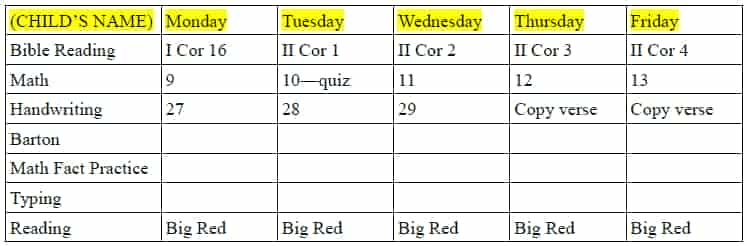
4. Put all the work you expect to get done in the week onto a chart. You’ll need to have assignments per day for some things, but other things (such as piano practice) would have a certain amount of time or work per day, and that would stay mostly the same for the whole week. Mom makes a simple table in a document for all of this. Here’s an example:

Chart Example
An example of what a chart for the week could look like.

Math fact practice and typing are a certain amount of time per day, as opposed to math or handwriting where there is a certain amount of work that has to be done per day. Each day, my brothers go through their lists and check everything off as they get it done. It works as motivation for them—most of the time—because they know that as soon as they have everything checked off they can be done for the day. It also helps Mom, because she can easily see who’s gotten what done—especially since she is currently teaching five children!

5. Offer rewards or consequences for achieving or missing assignments. This also helps as incentive to get things done. When you know you’ll miss a privilege if you don’t get your math finished in time, you tend to work faster. We also use rewards for people who get all their work done before a designated time (12:00, lunch time, etc.). Over the years, the rewards have changed—from a peanut butter ball, to 5¢ per day when finished in time, and several other variations along the way. Sometimes, we don’t have any reward at all.

One thing to keep in mind when considering making a chart is that you only want to list the essentials. Too far beyond that will make the work look overwhelming. If you want to do something extra, you could consider slipping that in to the afternoon instead of trying to fit it in the morning’s schedule. Less stress over a big workload makes a happier family.

Finding the right method for your family to stay on track can be difficult—but the end result is very rewarding. When you know what you expect yourself and your children to do each day, you can get a lot more done.

Question: Do you have problems staying on track and making sure everything runs together smoothly? What is one way you make the process easier? Share your thoughts in the comments below–I’d love to hear what you think about the subject!

  • « Go to Previous Page
  • Page 1
  • Interim pages omitted …
  • Page 55
  • Page 56
  • Page 57
  • Page 58
  • Go to Next Page »

Primary Sidebar

Find Me Online

  • Facebook
  • X
  • Instagram
  • Goodreads

Recent Posts

  • 2026 Reading Goals (& 2025 Goals Recap)
  • My Top 10 Favorite Reads from 2025
  • June TBR List: Classics and Miscellany
  • My Book Recommendations List Keeps Growing!
  • For the Love of Sourdough

Subscribe to Blog Updates

/* real people should not fill this in and expect good things - do not remove this or risk form bot signups */

Intuit Mailchimp

Recent Comments

  • Esther Filbrun on Banana Passionfruit Jelly/Jam
  • Monica Murray on Banana Passionfruit Jelly/Jam
  • Esther Filbrun on For the Love of Sourdough
  • birdyandnerdy on For the Love of Sourdough
  • Esther Filbrun on September TBR List // going WAY overboard with my selections (14 books!)

Disclosure

Some links on this site are affiliate links.

Archives

Copyright © 2026 · ·Refined Theme · Privacy Policy · Privacy Settings